Article
May 8, 2026
Build vs Buy: When Custom Software Actually Makes Sense
Every growing business hits this moment. You are running on a combination of tools, some subscription software, maybe a spreadsheet or two holding things together, and something is not working. Either the tools do not talk to each other, or they do not fit how your business actually operates, or you are paying for ten features and using two. Someone suggests building something custom. Someone else says that is expensive and unnecessary. The conversation goes in circles and nothing gets decided. This post is meant to end that conversation with a clear framework, not a generic answer, because the right answer genuinely depends on your situation.
Why Businesses Default to Off the Shelf
The default toward existing software is not irrational. Off the shelf tools are faster to get started with, cheaper upfront, and someone else handles the maintenance. For a business in its early stages, that tradeoff almost always makes sense. You do not know enough about your own operations yet to build something well fitted to them. The software forces a structure and that structure is often useful.
The problem comes later, when the business has grown into something specific. When your workflows are no longer generic. When the way you serve clients, manage operations, or generate revenue is genuinely different from what the software was built to handle.
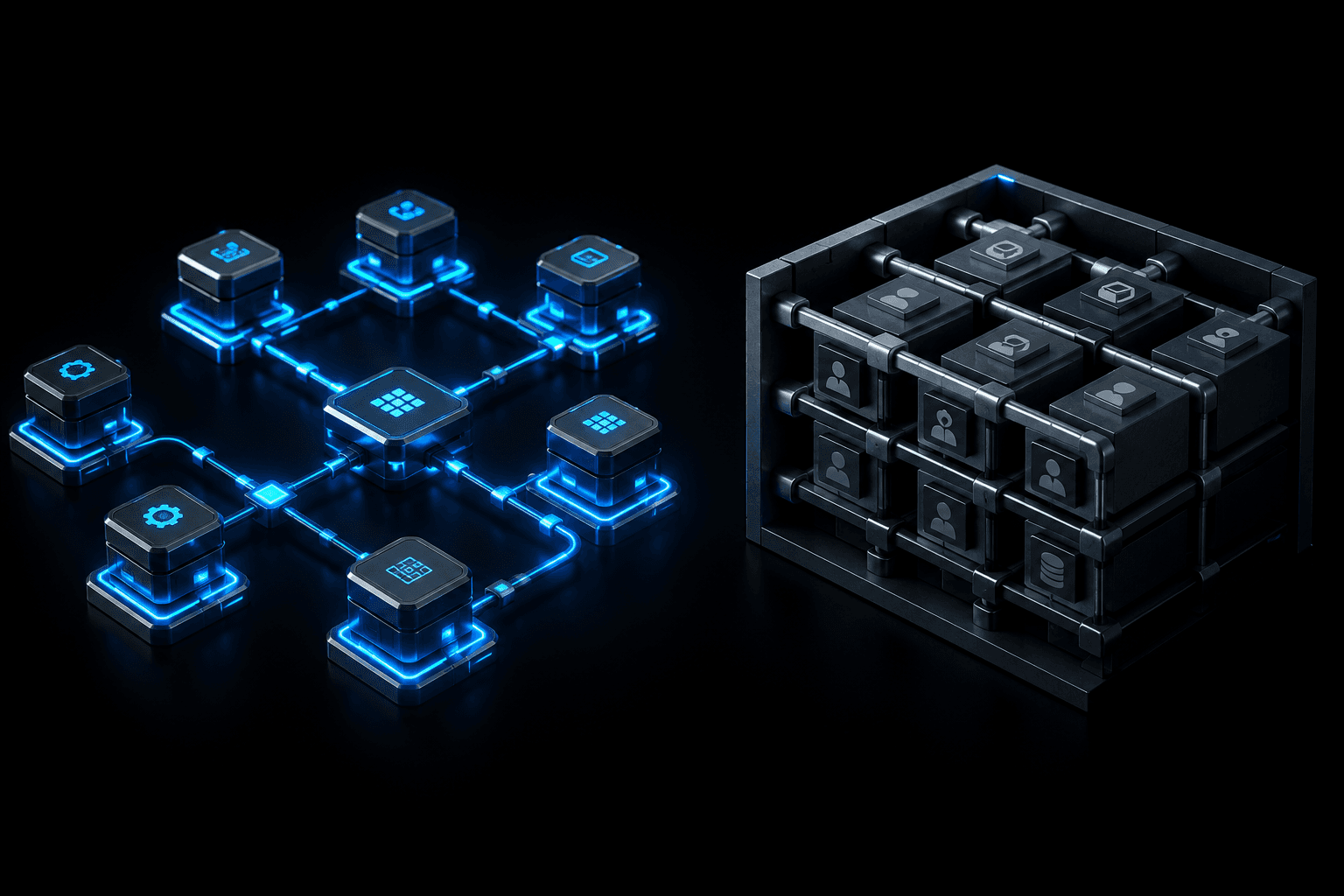
At that point the software stops being a foundation and starts being a ceiling.
The Real Cost of Off the Shelf Tools Nobody Talks About
The subscription cost is visible. The hidden costs are not.
When your team works around software limitations, that workaround has a cost. When data lives in three different tools that do not sync, the person manually reconciling that data is a cost. When a process that should be automatic requires a human step because the software cannot handle your specific case, that is a cost. When you cannot give a client a certain experience because your tools do not support it, that is a cost measured in revenue you never saw.
These costs do not show up on an invoice. They show up as hours lost, errors made, growth that stalls, and opportunities that disappear quietly.
Most businesses dramatically undercount them because they are invisible compared to a software bill.
When Off the Shelf Is Still the Right Answer
Before making the case for custom, it is worth being honest about when it is not the right move.
If your business is still early and your processes are still evolving, building custom software locks you into decisions you have not fully thought through yet. You will build something, your business will change, and you will have built the wrong thing. Wait until you know what you actually need.
If the off the shelf tool does 90 percent of what you need and the remaining 10 percent is genuinely minor, the math probably does not work for custom. Software development is an investment and it needs to return more than the cost of the problem it solves.
If your team will not use it, it does not matter how well it is built. Adoption is a people problem, not a technology problem, and new software does not solve a culture that resists process.
The Signs You Have Outgrown Your Tools
These are the patterns we see repeatedly in businesses that genuinely need something custom built.
Your team has built workarounds that have become permanent. When people stop complaining about a software limitation and start treating the workaround as normal, that is a sign the gap is real and ongoing. A temporary fix that has been running for a year is no longer temporary.
You are managing your operations across too many disconnected tools. If understanding the state of your business requires pulling information from four different places, you have an integration problem. Either the tools need to be connected or replaced with something that handles your workflow in one place.
Your competitive advantage is getting undermined by generic software. If the way you serve clients is genuinely different from your competitors and you are using the same off the shelf tools they are, the software is flattening what makes you different. Custom software can encode your specific process and make it repeatable and scalable in a way generic tools cannot.
You are turning down clients or limiting growth because of software constraints. This is the clearest signal. If the answer to "can we handle more volume" or "can we offer that" involves your software not being able to support it, the software is now a direct barrier to revenue.
You are paying for multiple tools to approximate one thing you actually need. Three subscriptions duct taped together to simulate functionality that should be seamless is a sign you have outgrown the available options.
What Custom Software Actually Gives You
The case for custom is not "it is better than off the shelf" in some abstract sense. It is specific.
Custom software is built around how your business actually works, not how a software company thinks businesses generally work. That means your team spends less time adapting to the tool and more time doing the actual work.
It gives you ownership. You are not dependent on a vendor's pricing decisions, feature roadmap, or decision to discontinue a product. The software is yours.
It scales with you. Off the shelf tools often have pricing that punishes growth. The more users, data, or volume you add, the more you pay, often in ways that were not obvious when you started. Custom software scales without the same compounding costs.
It becomes a competitive asset. A business that has built software precisely fitted to its operations is harder to replicate than one running on the same tools as everyone else in the industry.
The Questions to Ask Before You Decide
Is the problem real and ongoing, or is this a frustration that could be solved by using the existing tool better? Sometimes businesses want to build before they have fully explored what they already have.
Can you clearly describe what the software needs to do, step by step? If you cannot explain the process in plain language, you are not ready to build. The specification has to come before the development.
What is the actual cost of the current situation? Not the subscription cost of the tools you are using but the full cost including the hours lost, the errors, the growth that is not happening. If you cannot quantify the problem, you cannot evaluate whether the solution is worth it.
Do you have the right partner to build it? Custom software built poorly is worse than off the shelf software that fits imperfectly. The quality of execution matters enormously. The cheapest option rarely produces the best outcome and a failed build sets you back further than staying with what you have.
The Honest Answer
Build vs buy is not a philosophical debate. It is a practical question with a specific answer for your business at this specific moment in time.
Most businesses should start with off the shelf. Most growing businesses reach a point where off the shelf becomes the wrong call. The transition point is different for every business but it is almost always defined by the same thing: the gap between what your software can do and what your business actually needs has become expensive enough to fix.
When you reach that point, the question is not whether to build. The question is what to build, how to scope it, and who to trust with it.
If you are trying to figure out which side of that line you are on, we can help you think it through. No pitch, no pressure. Just an honest conversation about whether custom software makes sense for where you are and where you are going.